
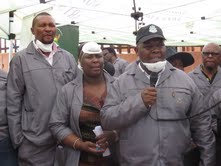
Transform SA Online interviews the Gauteng Department of Human Settlements MEC, Jacob Mamabolo, on the Gauteng Department Human Settlements’ mandate of providing decent, affordable accommodation and critical transformation issues including Enterprise Development, Skills Development and Employment Equity.
TSA: What are the Department of Human Settlements’ core focus areas of its transformation agenda as an organisation mandated with ensuring that the people of Gauteng have access, to at the very least, decent accommodation?
MEC: The Department has a number of programmes that communities can access, besides the RDP houses.
These programmes and policies are meant to benefit every citizen of the province, and they include:
- The Backyard Rental programme which was initiated as an additional component that tries to address rental provision shortages in the Province. The Department builds two roomed backroom for qualifying families that have shacks in their yards to use as rental accommodation.
- Rural Housing Programmes facilitate access to housing opportunities in rural areas. The Rural Housing Programme is used to extend the benefits of the Housing Subsidy Scheme to individuals living in areas referred to as “rural” areas where they enjoy functional security of tenure as opposed to legal security of tenure. Only individuals whose informal land rights are uncontested and who comply with the qualification criteria are granted such rural subsidies. Examples in Gauteng include Ethembeni Eco-Village in Muldersdrift.
- Community Residential Units (CRU), which is the conversion of hostel into family units. One of our flagship CRU projects is Jabulani Hostel, which was launched early this year.
- Finance Linked Individual Subsidy Program (Flisp) assists people who earn between R3501 and R15 000 per month in buying land, new or existing property. Persons can qualify for assistance starting from R10 500 up until R87 000 and the property or land may not cost more than R300 000.FLISP reduces the initial mortgage loan amount rendering the monthly loan repayment instalments affordable over the loan repayment term; and/or augments shortfall between the qualifying loan amount and the total house price.
- The Rental housing project is also driven by a growing demand for decent affordable rental housing, particularly for households whose income is less than R7 500 per month. Well located good quality, affordable rental housing is even more critical for such households because of their socio-economic status. In our mixed housing development we always include the rental option. Examples include the award-winning Fleurhof and others.
TSA: So far, in the past three years, what do you regard as the Department’s achievements in the following tenets of transformation:
- Skills development?
MEC: The Department through its Gender, Youth and Disabilities programme has managed to empower both internal and external people.
The external programme, among others, includes the coordination and monitoring of the National Youth Service (NYS) Programme within the Department; the facilitation, capacitating and Skills Development programme to people with disabilities on Construction, Business Management, Project Management and Occupational Health and Safety.
Internally, the programme provides support to Regions in mainstreaming GEYODI issues; monitor and advocatefor the creation of job opportunities within the Department (direct) and at the Departmental projects (indirect) focussed on targetedgroups, i.e. Youth, Women and People with disabilities.
- Employment Equity?
MEC: The Gauteng Department of Human Settlements is doing fairly well in employment equity. The latest numbers show that 52 percent of employees in the department are women. The Department is also happy that the number of women in senior positions has increased to 44 percent and that both the Head of Department and the Chief Financial Officer are also women. The Department is going to work hard in recruiting skilled and experienced women in order to reach the 50/50 ratio or even surpass it.
- Enterprise Development?
MEC: The department has resuscitated its contractor incubator programme which focuses on training contractors. The three year programme received overwhelming response when it was advertised and 30 companies were selected. These companies are made up of 10 companies owned by women, 10 owned by people with disabilities and 10 by young people. For the duration of the incubator, work worth R500 million has been ring fenced for the contractors.
TSA: In which areas, if any, do you think the Department needs to improve?
MEC: Land invasion has been at the core of housing delivery and allocation for a long time. Invasions have also taken another form, particularly in theinner cities or other economically active sectors of the communities, as property or building invasions. Land invasion refers to an illegal occupationof land, with the intention of establishing dwelling(s) or settlements upon it. This could either be on a vacant undeveloped land, or within the existing settlement(s).
Such invasions occur on either privately owned land or state owned land. In the past financial year housing developmentin the Lenasia area was prevented by the latest invasion and corruption that saw the earmarked land invaded. This led to numerous court casesand money spent trying to resolve the situation, which stood in the way of delivery and the state’s obligation to provide housing to its citizens, asper the Constitution’s section 26 (1) & (2).
Despite the existing legislation that is aimed at addressing such matters (PIE Act), the Province identifieda need for a Land Invasion Framework to be developed to address invasions in a cohesive and consistent manner. The proposed framework has been developed. In the forthcoming financial year, the framework will be finalised and adopted as a policy direction for addressing invasions in the province.
The elimination of land invasions and illegal occupation of state land will subsequently ensure the reduction of informal settlements. As the Department, we must also express concern that certain political parties seem to encourage people to invade land.
Another area of concern is illegal evictions of people. All too often the victims are poor people who are left homeless. We have forged ties with Sheriffs and eviction security companies to try and ease the pain for the victims of evictions. Through this partnership, we are able to verify if the court order was acquired legally and lawfully. Remember no eviction can be done without a proper eviction order from a court of law.
TSA: Some of the challenges that the provincial government has to deal with urgently are recurrent service delivery protests from people who have been on the waiting list of RDP house beneficiaries. As the Department, what efforts are you making to improve service delivery?
MEC: The Department came up with a service delivery improvement plan which has many ways of improving services, relating to the issue of protest. The department has taken an approach to consult with the people in order to avoid protest. This has proven to work when looking at the intervention the Department did in Bekkersdal.
Worth noting, in his State of the Province Address Premier Makhura committed that government leaders will go across the length and breadth of Gauteng to meet and engage with all communities that would like to raise issues and problems with government.
Further, the Department hosts Imbizos and public meeting to understand the needs of the residents and the best way to find a solution to their grievances. The Department has also developed a Complaint mechanism which can be used by the communities. The Premier’s Office has also established the War Room, which will put the province under the microscope to make sure that issues are dealt with on time lest they spill into violent service delivery protests.
We still believe that talking with our people is still the best mechanism and so far it has been yielding positive results.
The Department also realised that our communities needed information and we are using visible posters, flyers and booklets as service delivery information tools.
TSA: What is the Department doing to address the challenge of the huge backlog of the construction of RDP houses?
MEC: The issue of addressing the housing backlog in Gauteng has to be understood in the context that it is a moving target. Gauteng is the most populous province in South Africa, with a land area of approximately 16 548 square metres, housing a population of 12.3 million people. The population has been growing rapidly as a result of migration and natural growth. According to Statistics South Africa, in 2011 the average Gauteng population constituted 23.7% of the total South African population.
Gauteng has had the fastest growing population, followed by KZN and the Western Cape, which experienced the second largest absolute and relative population increase respectively. Gauteng is affected by in-migration and migration. Millions of migrants from neighbouring countries settle in Gauteng in pursuit of economic and employment opportunities, which ultimately impacts negatively on infrastructure andservice delivery. These statistics show again that these patterns will continue as Gauteng remains a destiny of choice for many job seekers, and is regarded as the “land of milk and honey”.
This has led to the demand for housing being greater than anticipated. The growth and migration (movement) in the population has led to a greater increase in the number of households in need of services. The urban population has increased in terms of informal settlements and backyard dwelling. Unemployment has led to an increase in the number of households requiring subsidised housing.
Unfortunately, the supply of housing is not keeping up with the need for housing due to a shortage of affordable well located land available for low cost housing. Housing development is built on the outskirts of urban areas where residents have limited access to economic activities/ opportunities.
Through this, the Department came up with a service delivery improvement plan which will prioritise the provision of mixed housing to suit low income earners, middle income earners and high income earners. This plan will benefit all qualifying residents of targeted Informal Settlements, earning between R0-R3501-R12 500.
As the Department we are also happy that we are leading in the intake of the Financial Linked Individual Subsidy Program (Flisp). Close to 500 people who could not afford buying houses before are now home owners. The Department has assisted them with R15million in subsidies. (See question 1)
TSA: On youth unemployment, recent information from Statistics SA indicates that the situation is worsening. What are some of the sustainable ways in which this challenge can be tackled?
MEC: The Department continuously ensures that we cater for the special/designated groups such as the youth, women, and people with disabilities (PWDs), through mainstreaming Gender, Youth and Disabilities (GEYODI) programmes and job creation in the Department.
Our efforts are noticeable to an extent that the Department has resuscitated its Incubator Programme, which plans on hosting 30companies that are owned by the following designated groups: 10 women, 10 youths, and 10 PWDs. In as far as job creation is concerned, I am also happy to report that the Department created a total of 13 189 jobs, which benefited 1 716 adult females, 1 456youth females, 76 PWDS, 5 764 adult males and 4 177 youth in the 2013/14 financial year.
GEYODI mainstreaming and job creation form the core of the Department’s priorities and responds to the call to address the injustices of the past, inequalities that persist to exist, promotion of equality and empowerment of these designated groups of people.
