
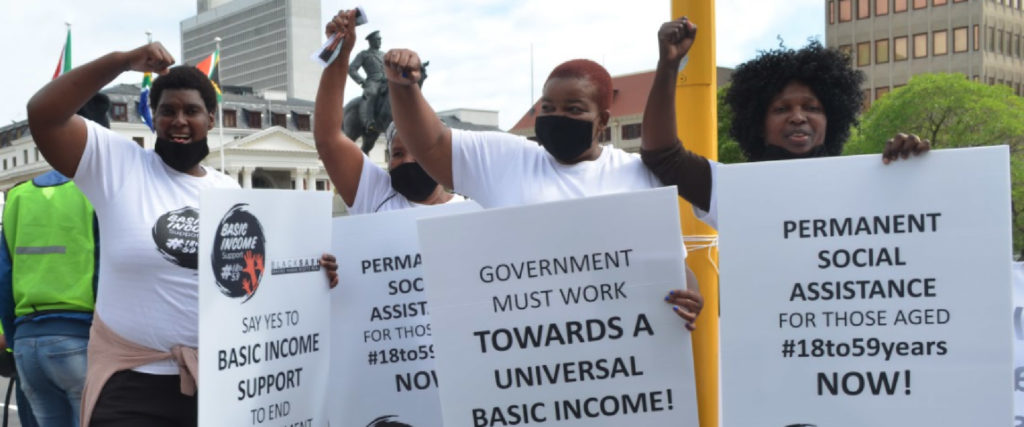
It is sad that, 27 years after the dawn of the country’s democracy, the majority of South Africans are still stuck in a rut where they can barely make ends meet, at best, or just do not have the means, at worse. Some have argued that, the situation could have been different had there been sound governance, citing harrowing levels of corruption in public procurement processes. However, that would be delving into a different topic altogether.
The fact of the matter is that the current economic situation – of course exacerbated by COVID-19 containment measures – places a mammoth moral obligation on the government to apply whatever means to soften the impact on the underprivileged citizenry. Earlier this year, President Cyril Ramaphosa, broached the idea of introducing a ‘Social Safety Net’ in the form of a Universal Basic Income Grant, as a permanent measure.
Colossal cost
Nevertheless, there is a colossal cost attached to fulfilling the moral obligation of providing the Basic Income Grant, which the current economic situation would render untenable.
Currently, the government fiscus is overburdened with tackling a number of urgent needs, and so, the Basic Income Grant may only be a very temporary band aid, and not the perceived cure for the plight of the majority. In the main, the issues to on the government’s priority list to be addressed, would include but not isolated to the provision of necessary equipment and infrastructure for health (with the current covid-19 pandemic), education infrastructure, and others.
More to the point, slow economic growth and the struggling businesses and closure of some in different sectors translates into reduced tax revenue. Professor Philippe Burger of the University of the Free State, warns about the risks of adding more welfare recipients in an economy that is not growing.
Undoubtedly, the ideal situation would be an atmosphere where there is economic growth through increased business activity and emergence of new enterprises. In this way, more employment opportunities would be created and the government would collect more tax revenue. This would reduce the burden on the government to provide a Basic Income Grant and as they would be fewer recipients. The current expanded definition of unemployment at 71% could mean more people would register for the grant .
From this stance, one would appreciate the point the Minister of Enock Godongwana, raised in his interview with The Sunday Times on the basic income grant. The Minister said he feared that, inadvertently, the basic income grant, though well-intentioned, would create a ‘cycle of dependency’ amongst the country’s unemployed youth, an economic obligation that government may not manage to sustain in the long-term.
Definitely, the contention that the Basic Income Grant may not be sustainable, echoes what others have expressed before. Some have already labelled South Africa, “the world’s biggest welfare state“.
Some organisations and analysts have concurred with the Minister’s fears on the Basic Income Grant.
The most high profile of them all, Business Unity South Africa (Busa),toes the new Finance Minister’s line. The organisation’s CEO, Cas Coovadia, has warned that, a basic income grant would create a bigger fiscal challenge and would be unsustainable in the absence of economic growth. Instead, he suggested, “”We do need to open up the country for investment and on the back of that create inclusive growth that looked for job-creating opportunities.”
“Our people” Need Certainty
But where does that the current situation leave ‘Our People’, as politicians often call ordinary South Africans, between now and the time the economy would have rebounded, when there is no certainty?
People need the certainty of consistent subsistence of sorts, sooner than later, after the current temporary grant which, thankfully, has been resumed, lapses. They need food and do not have time to bank their hopes on the decisions being made stimulating business activity.
Between a rock and a hard place
The exact cause of the recent civil unrest, where property had been vandalised and looted at a worrying scale, cannot pinpointed with certainty – several have been advanced. However, there is no doubt, as it has emerged during recent joint police and army operations to impound goods that had been looted, that the worsening economic conditions were one of the contributing factors.
As opposed to peddling the basic income grant as a cure-all, the Minister of Finance proposed focus on creating jobs by spending money on upskilling SA’s 4.2 million job seekers between the ages of 15 and 35. He said programmes to support people should include social support and skills programmes. Noticeably, he did not mention Basic Income Grant as his idea of the social support programme.
It has to be pointed out, though, that upskilling the youth so that they adequately qualified to meet demand in the economy is not an event, but a process. Frankly, the yield of well-qualified youth can only be realised in the medium to long-term.
Plainly, without being alarmist, any slow economic recovery, which would result low employment opportunities, would potentially lead to a resurgence of social unrest. And the Basic Income rant would alleviate the impact of economic hardships on low-income households, which could forestall a repeat of the recent unrest, as Abongile Nkamisa of Centre of Applied Studies, Wits writes.
Yet this is a luxury the fiscus cannot afford at this juncture. This puts government in horns of dilemma, caught between a rock and a hard place.
Facing the challenge squarely
But there is no in wallowing in self-pity, it is important to bite the bullet and face the challenge squarely in the face.
In the here and now, what is needed are decisive actions in the shape of the national infrastructure expenditure, first publicised during President Jacob Zuma’s tenure, that has been put on ice since 2010. If what analysts have been going to town on the need of government -led expenditure is anything to go by then, the economy would be given a new lease on life, resulting in job creation, as the 2010 World Cup did. Ultimately, there would be less burden on the government to be providing a Basic Income to millions of unemployed youth.
